Technical Notes · Maintain
Specifying a pressure calibrator for site maintenance
Home · Technical Notes · Specifying a pressure calibrator for site maintenance
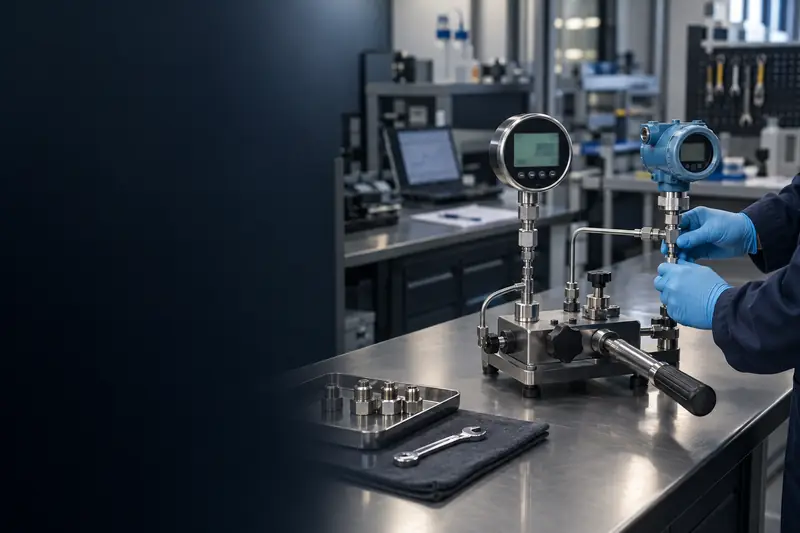
A portable pressure calibrator lets a maintenance team check gauges, transmitters and switches in the plant instead of pulling them back to the workshop. Choosing one comes down to a few questions, and getting them right first saves buying the wrong range or the wrong pump.
1. Ranges you actually check
List the instruments you need to check and their ranges. Note whether they are gauge, absolute or differential, and whether any read vacuum. A calibrator is most accurate in the range its pressure module or sensor is built for, so one wide-range sensor is rarely the best choice for both low-pressure and high-pressure work. Many teams pick a base unit plus interchangeable pressure modules.
2. Accuracy you need
A common rule of thumb is that the reference should be several times more accurate than the instrument under test. Check how the manufacturer states accuracy (percent of reading or percent of full scale), over what temperature band, and for how long after calibration.
3. How you generate pressure
- Hand pump (pneumatic): typical for low and medium pressure, and for vacuum.
- Hydraulic hand pump: for high pressure; consider the fluid and contamination of the instrument under test.
- Built-in pump: convenient for frequent low-pressure checks, at the cost of size and battery.
4. Electrical side
For transmitters you will usually need to measure 4–20 mA, often while supplying 24 V loop power. For smart transmitters, check whether you need HART or another protocol, and whether that is built in or needs a separate communicator. For pressure switches, look for switch-test functions.
5. Documenting and records
A documenting calibrator can store procedures and as-found / as-left results and export them to calibration software. If your quality system needs that, say which software you use.
6. Site conditions
Hazardous-area work needs equipment certified for the zone. Also consider ingress protection, battery life and the fittings and hoses needed to connect to your instruments.
7. Certification
Say what certificate you need with the calibrator: a manufacturer's certificate, or a UKAS-accredited certificate arranged through a third-party laboratory. Obsidian Dynamics is not UKAS-accredited and does not operate a calibration laboratory.
What to send
The list of ranges and types, the accuracy you need, the electrical functions, hazardous-area needs, and any calibrator you already use (manufacturer and model). If you are replacing a discontinued calibrator, send its manufacturer and model too; Instrument Exchange can look for the original.